
Japanese Damascus Knives
Japanese knives are built for precise cutting. Slim profiles, hard steels, shapes that evolved for one job each. A Japanese Damascus knife adds pattern-welded cladding to that: a hard core wrapped in layers, etched so the pattern shows.
The pattern is cosmetic. The shape, the core steel and the hardness decide how the knife cuts, and we publish all three on every listing. Right now our Japanese range is five knives: three santokus and two bunkas.
The shapes we stock
| Shape | What it does | Ours |
|---|---|---|
| Santoku | Slicing, dicing, mincing — straight-down chopping with a flat edge | HEZHEN 5.5″ ($99), SHANGDAO 6.6″ ($105), XINZUO 7″ ($139) |
| Bunka | A santoku with a pointed, angled tip — better for fine tip work and scoring | 5″ Bunka ($28), F.YOUNG 6″ Bunka ($35) |
All three santokus also live in our Santoku Knives collection.
Gyuto, nakiri and kiritsuke are the other shapes you will hear about. Our guide covers all of them: Japanese Damascus Knives: Santoku, Nakiri, Gyuto & Kiritsuke Explained.
The steels in our Japanese knives
Three core steels across the five knives. VG-10 is the standard on Japanese-style Damascus: a high-carbon stainless steel, hardened to 60–62 HRC, sharp, rust-resistant and easy to look after. Two of our knives use it. 10Cr15CoMoV is the Chinese steel that matches VG-10’s makeup almost exactly — the HEZHEN santoku uses it at 60±2 HRC. AUS-10 is a Japanese stainless steel, tough and easy to sharpen — the 5″ bunka uses it at 60±2 HRC.
SG2 is the steel people ask about next. It is a powder steel: harder, holds an edge longer, costs more. It is also harder to sharpen and more brittle if you twist the blade. We do not stock SG2 yet. For most home cooks VG-10 is the better buy — more forgiving and far cheaper. Do not pay SG2 prices for a knife you will treat like a VG-10 knife.
Single bevel vs double bevel
Most Japanese knives sold outside Japan are double-bevel: sharpened on both sides, like a Western knife. Traditional Japanese knives are single-bevel: sharpened on one side only, with a flat or hollow back. A single-bevel knife cuts with extraordinary precision, but it needs specialised sharpening and is usually made for right-handed use. Unless you know what you are buying, stick to double-bevel.
Care
Japanese steels are harder than Western steels, which means they hold an edge longer and chip more easily. Do not twist the blade, do not pry with it, and do not cut frozen food or bone. Hand wash, dry immediately, store dry. Full guide: How to Care for a Damascus Knife.
Common questions
What is the best Japanese Damascus knife for a beginner?
An 18cm santoku. It is compact, easy to control, and does the three jobs most home cooking needs — slicing, dicing, mincing. Our XINZUO 7″ santoku is the closest to that size; the HEZHEN 5.5″ is the smallest of the three.
Is VG10 or SG2 better?
SG2 holds an edge longer but is harder to sharpen and more brittle. VG-10 is more forgiving, cheaper and easier to maintain. For most home cooks, VG-10 is the better choice.
Are Japanese Damascus knives made in Japan?
Some are, usually forged in Seki. Many sold as “Japanese Damascus” are made in China with Japanese-style shapes and steels — ours included. The word “Japanese” in a listing describes the style. Ask the seller where the knife was forged if origin matters to you.
What is the difference between a santoku and a bunka?
A bunka is a santoku with a pointed, angled tip. The santoku’s spine curves down to a rounded tip; the bunka’s drops to a sharp point, which suits fine tip work and scoring. Both have a flat edge for straight-down chopping.
How do I sharpen a Japanese Damascus knife?
On a whetstone, at the angle the knife was ground to — usually 15 degrees per side for a double-bevel knife. Single-bevel knives need specialised technique. Full guide: How to Sharpen a Damascus Steel Knife.
Showing all 5 results
-
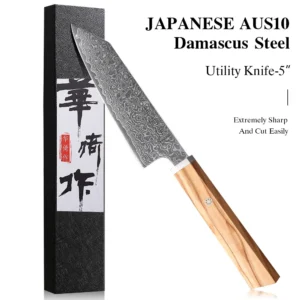
5-Inch Damascus Bunka Knife — AUS-10 Core, Olivewood Handle
$ 28 Add to cart -
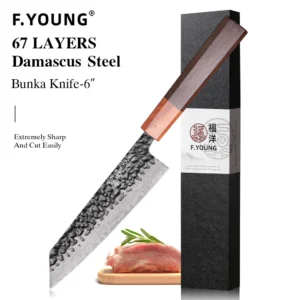
F.YOUNG 6-Inch Damascus Bunka Knife — VG10 Core, Rosewood Handle
$ 35 Add to cart -
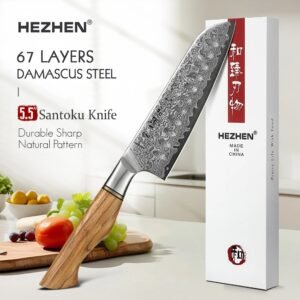
HEZHEN 5.5-Inch Damascus Santoku Knife
$ 99 Add to cart -
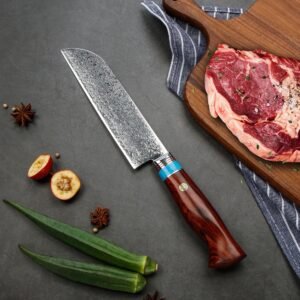
SHANGDAO 6.6-Inch Damascus Santoku Knife
$ 105 Add to cart -
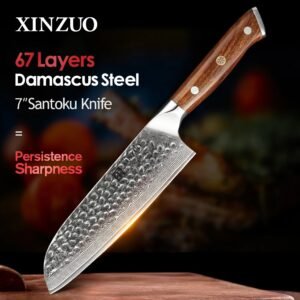
XINZUO 7-Inch Damascus Santoku Knife
$ 139 Add to cart